Gb7(#11) Guitar Chord | Play, Hear and Practice Interactively
Want a structured chord roadmap instead of jumping between pages?
Go to the full guitar chords tutorial.
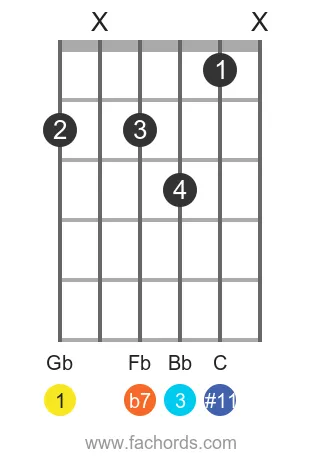
Take the dominant seventh Gb, Bb, Db, Fb, add the raised eleventh C, and you have Gb7(#11) (Gb seventh sharp eleven). Its natural fifth Db stays in the chord, so it is a full dominant seventh with a raised eleventh on top, not a flat five chord.
The single voicing here runs from fret 1 to fret 3, and it is not a barre shape. It sounds identical to F#7(#11), the same chord under a different spelling. Try the Gb Lydian Dominant scale next. It is the fourth mode of the melodic minor scale and it contains all five chord tones, so it fits the chord from start to finish.
Pick a tempo for the drum loop in the tool at the top of the page and repeat the chord in time.
Gb 7th with sharp 11th guitar chord is also written as Gb7(#11), Gb7#11 or Gb7+11.
Notes of the Gb 7(#11) chord:
Chord Structure:
Formula: 1 3 5 b7 #11
Gb 7(#11) Guitar Chord Diagrams
Position 1 Movable
Finger Positions
- Mute the A string
- Mute the high E string
- Place your index finger (1) on the fret 1 of the B string
- Place your middle finger (2) on the fret 2 of the low E string
- Place your ring finger (3) on the fret 2 of the D string
- Place your pinky finger (4) on the fret 3 of the G string
 Find more shapes in our all guitar chords online library. If you
prefer a printable pdf, download
the Free Guitar Chords Chart Pdf
Find more shapes in our all guitar chords online library. If you
prefer a printable pdf, download
the Free Guitar Chords Chart Pdf

Created by
Giancarlo is a musician (teaching guitar since 2000), software engineer, AI consultant and published researcher
FAQ
What notes are in the Gb seventh sharp eleven chord?
Gb, Bb, Db, Fb and C. The Fb is the minor seventh and sounds like E natural. The C is the sharp eleventh.
Is Gb7(#11) the same as F#7(#11)?
Yes, they sound identical. F#7(#11) is spelled F#, A#, C#, E and B#, while Gb7(#11) uses Gb, Bb, Db, Fb and C.
Why is the sharp eleventh of Gb7(#11) a plain C?
The eleventh higher than Gb takes the letter C. The natural eleventh is Cb, and raising it by a half step gives C natural, a tritone from the root in pitch.
Which scale works over Gb7(#11)?
The Gb Lydian Dominant scale, spelled Gb, Ab, Bb, C, Db, Eb and Fb, contains all five chord tones. It is the fourth mode of the melodic minor scale.
How many voicings does Gb7(#11) offer?
One voicing is listed, from the first fret to the third fret. It uses no open strings and is not a barre voicing.