Explore F#13 Guitar Chord Shapes: Interactive Learning & Practice
F#13, the F# dominant thirteenth chord, is spelled F#, A#, C#, E, G#, B and D#. It sounds identical to Gb13, and the D# is the thirteenth.
Six voicings are listed. Four of them are barre shapes, none uses an open string, and the lowest starts at the 2nd fret. If you want the essence without all seven notes, shell voicings keep only the root, third and seventh. The F# Mixolydian scale contains every tone.
Choose a tempo, start the drum loop in the player and play along with the chosen shape until the barre feels settled.
F# dominant 13th guitar chord is also written as F#13, F#dom13 or F#7(13).
F#13 Chord Notes and Formula
F# 13 chord Notes:
Tones of the Dominant Thirteen chord:
Formula: 1 3 5 b7 9 11 13
Same chord, different name: F#13 is also written as Gb13 (Gb dominant thirteenth).
F# 13 Chord Interactive Fretboard
Want a structured chord roadmap instead of jumping between pages?
Go to the full guitar chords tutorial.
F# 13 Guitar Chord Diagrams
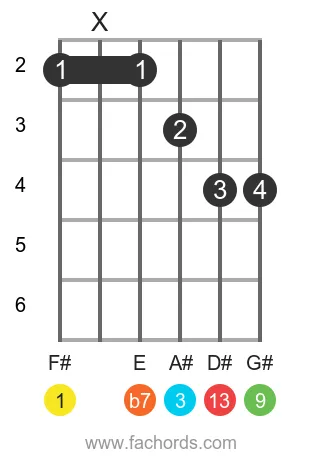
Position 1 Barre Movable
Finger Positions
- Mute the A string
- Place your index finger (1) on the fret 2 of the low E and D strings at the same time
- Place your middle finger (2) on the fret 3 of the G string
- Place your ring finger (3) on the fret 4 of the B string
- Place your pinky finger (4) on the fret 4 of the high E string
Position 2 Barre Movable
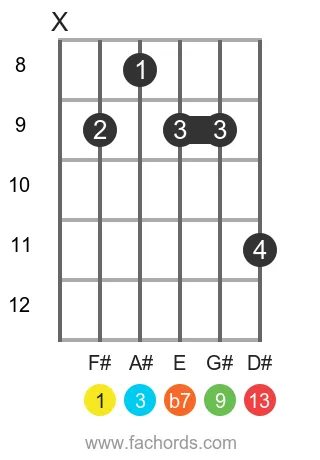
Finger Positions
- Mute the low E string
- Place your index finger (1) on the fret 8 of the D string
- Place your middle finger (2) on the fret 9 of the A string
- Place your ring finger (3) on the fret 9 of the G and B strings at the same time
- Place your pinky finger (4) on the fret 11 of the high E string
Position 3 Barre Movable
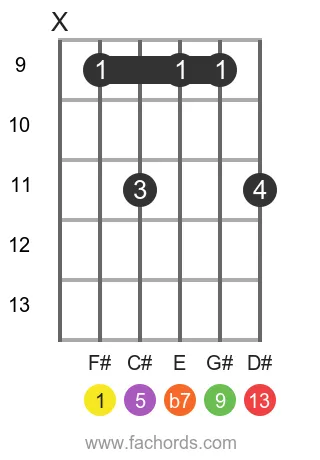
Finger Positions
- Mute the low E string
- Place your index finger (1) on the fret 9 of the A, G and B strings at the same time
- Place your ring finger (3) on the fret 11 of the D string
- Place your pinky finger (4) on the fret 11 of the high E string
Position 4 Movable
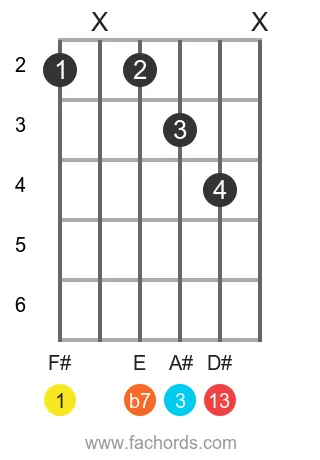
Finger Positions
- Mute the A string
- Mute the high E string
- Place your index finger (1) on the fret 2 of the low E string
- Place your middle finger (2) on the fret 2 of the D string
- Place your ring finger (3) on the fret 3 of the G string
- Place your pinky finger (4) on the fret 4 of the B string
Position 5 Movable
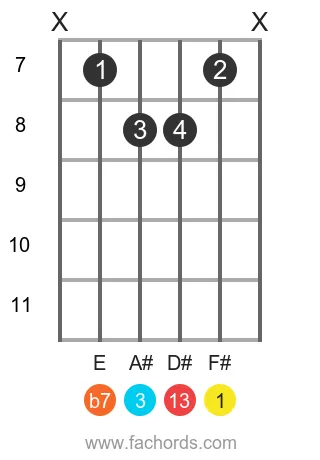
Finger Positions
- Mute the low E string
- Mute the high E string
- Place your index finger (1) on the fret 7 of the A string
- Place your middle finger (2) on the fret 7 of the B string
- Place your ring finger (3) on the fret 8 of the D string
- Place your pinky finger (4) on the fret 8 of the G string
Position 6 Barre Movable
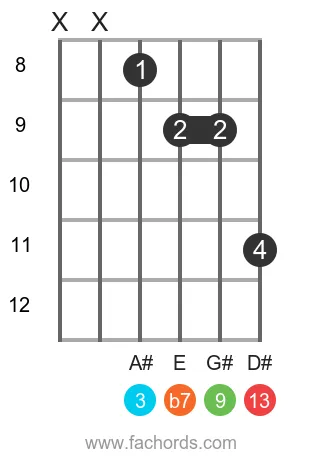
Finger Positions
- Mute the low E string
- Mute the A string
- Place your index finger (1) on the fret 8 of the D string
- Place your middle finger (2) on the fret 9 of the G and B strings at the same time
- Place your pinky finger (4) on the fret 11 of the high E string
 Find more shapes in our all guitar chords online library. If you
prefer a printable pdf, download
the Free Guitar Chords Chart Pdf
Chords That Go With F#13
One key where F#13 fits is B major, where it works as the V chord. These are the main chords of that key, the ones you will often hear around it:
See every key in the guitar keys chart, or build a progression with these chords in the chord progression generator.
More F# Chords
Want to know how this chord is built? Read dominant chords explained, or browse all F# guitar chords.

Created by
Giancarlo is a musician (teaching guitar since 2000), software engineer, AI consultant and published researcher
FAQ
What notes are in F# dominant thirteenth?
F#13 contains F#, A#, C#, E, G#, B and D#. The D# is the thirteenth, a major sixth over the root.
Is F#13 the same as Gb13?
Yes. Gb13 reads Gb, Bb, Db, Fb, Ab, Cb and Eb, the same seven pitches as F#13 with flat names.
Which scale contains every note of F#13?
F# Mixolydian is F#, G#, A#, B, C#, D# and E. It has the same seven notes as the chord, with D# as the thirteenth.
How many ways are there to play F#13?
There are 6 voicings, from fret 2 to fret 11. Four of them are barre voicings and none uses an open string.
What do the intervals 9, 11 and 13 mean in F#13?
They are G#, B and D#: a major ninth, a perfect fourth and a major sixth over the root, each named an octave higher.