Add 9 Arpeggios
Improve Your Melodies Instantly
In this lesson, I want to give you a straightforward tip that will help you improve your guitar solos.
If you have been practicing lead guitar for some time, you already should know that triads are a great way to create pleasant melodies.
Now we will take a step forward: here's the Ninth!
The 9th is the note that you find 2 half-steps above the upper root, so, in the case of the C major scale, we have:
The note D is the 9th. So far so good, now let's explore the possibilities of this simple addition.
Add9 Arpeggio - Interactive Tool
Use this interactive tool to learn add9 arpeggios across the entire fretboard:
Add9: The Sound Of A Ninth
The Ninth has an interesting sound: it's sweet and brings a little tension at the same time.
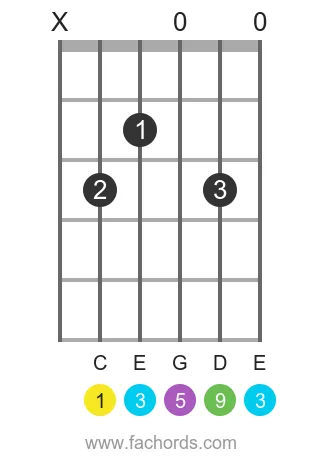
To instantly perceive this nuance, try to play a standard C major followed by a C add 9 chord, back and forth.
C Major Chord
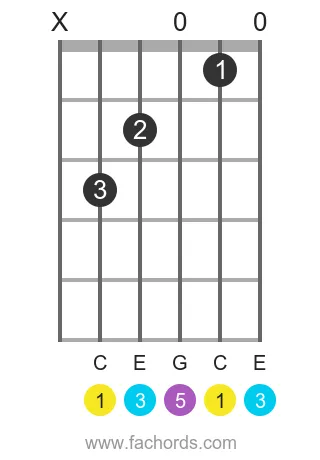
C Add 9 Chord
Sounds cool, is it right?
Tip: To switch between C and C add9, you could also use the pinkie to press and release the 3rd free of the B string.
C Add 9 Vs C9
Before proceeding, we have to clarify one thing.
We say C add9 and not C9 because the standard rule in chord naming is:
- If we add an extension (a note up the 7t, like 9th, 1st, 13th..) to a chord, and the 7th is not in the chord, we use the symbol add
- If the 7th is in the chord, the extension takes its place, so C7 add 9th becomes C9.
In fact, the notes in C add9 are: C, G, E and D (there's no 7th)
The notes in C9 are: C, G, E, Bb and D (Bb is the 7th)
CAGED Shapes For The Add 9 Arpeggio
Ok, now let's try to find our way on the fretboard and see how to use the 9th in our solos.
Here's the CAGED shapes:
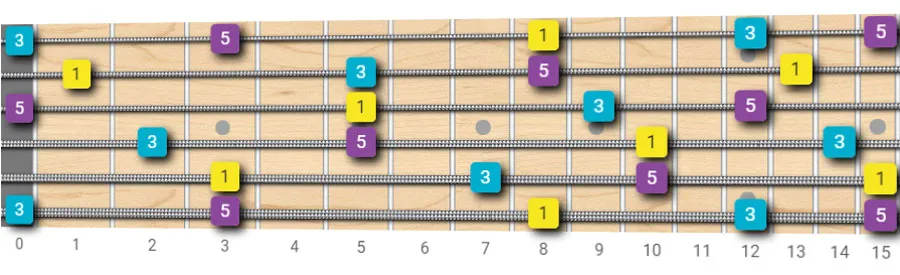
Now the add 9th version of the CAGED system. Just add the note 2 frets up the root (the 9 in green).
Note that we can consider the 2nd and the 9th as the same note.
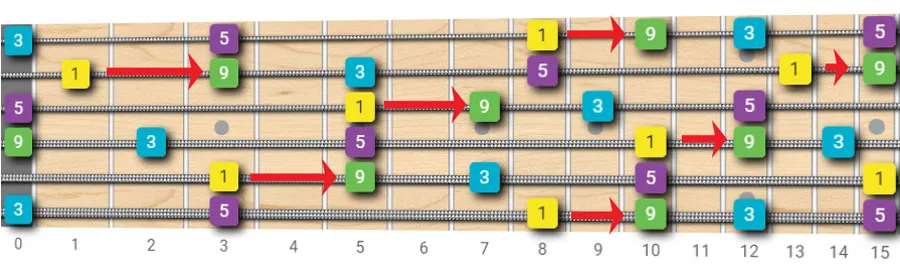
With these maps, we can now identify some cool arpeggio shapes.
Note: we show the arpeggio for the root of C, but, any other pattern on guitar, these shapes are shiftable up or down the neck to play the pattern in another root.
Major Add 9 Arpeggios
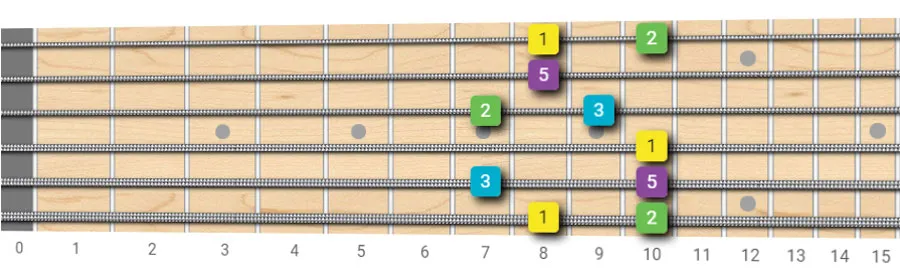
The major add 9 arpeggio is a major triad and a 9th, so 1, 3, 5 and 9th.
This first fingering has the root note on the lowest E string.
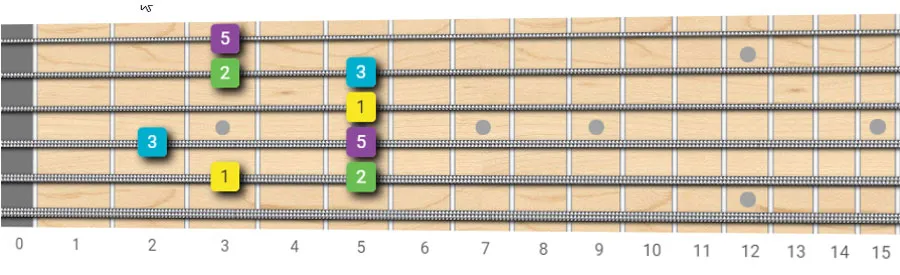
Another pattern, this time with root note on the A string.
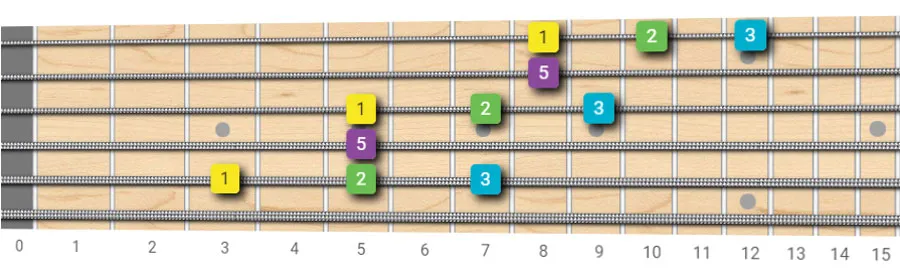
This is an extended pattern that unfolds across the fretboard.
Minor Add 9 Arpeggios
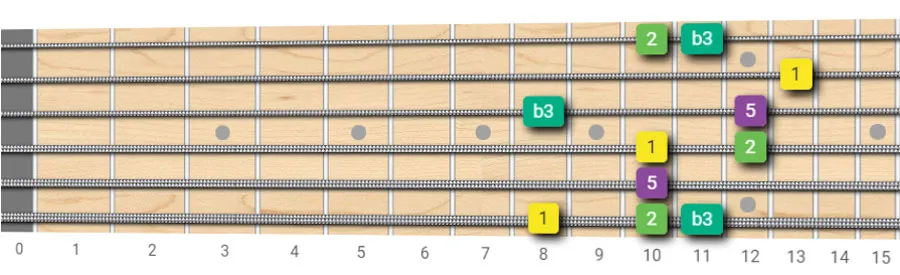
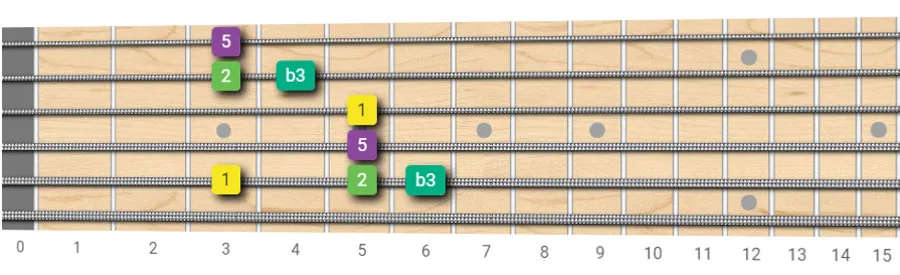
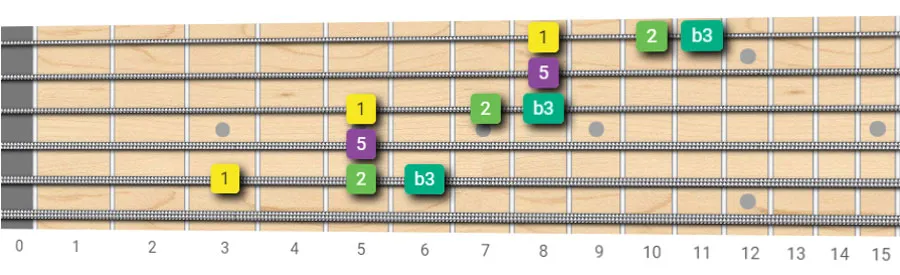
The minor add 9 arpeggio is a minor triad and a 9th, so 1, b3, 5 and 9.
Fingering for the minor version with root on the 6th string.
Root on the 5th string, 4-frets-box configuration.
Another extended pattern that repeats the same shape across different strings, this concept is called chunking.
Add 9 Arpeggio - Final Exercise
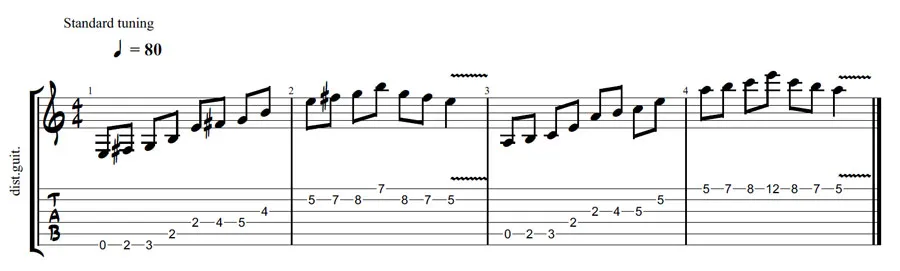
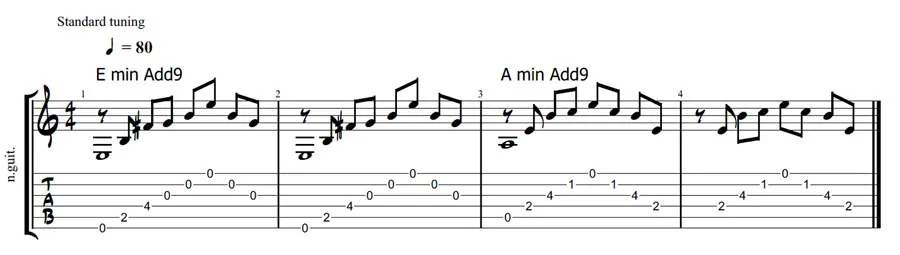
I'll leave you with a nice tune based on E min Add 9 (E, G, B and F#) and A min Add 9 (A, C, E and B).
The lead guitar plays an extended arpeggio using the chord tones of the underlying chord, starting from the E and A open strings.
Lead guitar
Chords
Ok, this ends our add 9 arpeggios lesson.
You can stay updated here , you'll also get access to the free download area with plenty of resources, including a major and minor add9 arpeggios pdf

Created by
Giancarlo is a musician (teaching guitar since 2000), software engineer, AI consultant and published researcher
FAQ
What is the primary benefit of incorporating add9 arpeggios into my guitar playing?
Adding the 9th to your arpeggios or solos instantly enriches your melodies. It provides a unique sound that is described as both 'sweet' and subtly tension-filled, making your lead guitar lines more expressive and sophisticated than relying solely on basic triads.
How do I determine the 9th note for any given root note?
To find the 9th note, you simply count two half-steps (or one whole step) above the upper octave of your root note. For example, if your root is C, the 9th note would be D, which is two half-steps above the C an octave higher. This D is functionally the same as the 2nd degree of the C major scale, but it's called the 9th when used as an extension.
What is the crucial distinction between an 'add9' arpeggio and a '9th' arpeggio?
The key difference lies in the presence of the 7th. An 'add9' arpeggio (or chord) *only* adds the 9th to a basic major or minor triad (1-3-5) and *does not* include the 7th. For example, a C add9 contains C, E, G, and D. In contrast, a '9th' arpeggio (or chord) *always* includes the 7th along with the 9th. For example, a C9 contains C, E, G, B♭ (the 7th), and D (the 9th).
How do the notes in a Major Add 9 arpeggio differ from a Minor Add 9 arpeggio?
Both Major Add 9 and Minor Add 9 arpeggios share the 1st, 5th, and 9th notes. The defining difference is the third: a Major Add 9 arpeggio includes a major third (1, 3, 5, 9), while a Minor Add 9 arpeggio uses a minor third (1, ♭3, 5, 9). This single note determines the overall major or minor tonality of the arpeggio.
How can I use the CAGED system to understand and locate add9 arpeggio shapes on the fretboard?
The CAGED system provides a familiar framework. You can visualize the standard CAGED shapes for a given chord and then integrate the 9th. The 9th note is found two frets (a whole step) above any root note within that CAGED shape. By identifying and including these 9th notes, you can adapt your existing CAGED knowledge to play add9 arpeggio shapes across the fretboard, which are fully movable for different keys.